


Diamond Powder Particle Size Knowledge
Diamond materials, as advanced powder materials, are not only defined by chemical composition, but also by a range of physical properties. These include particle size, particle morphology, specific surface area, pore structure, electrical charge characteristics, as well as bulk density and flowability. Among these, particle size distribution is one of the most important parameters in Diamond Powder production and application.
1. Particle Size Classification of Diamond Powder
Diamond particles can generally be classified into the following size ranges:
- Nanometer particles (1–100 nm)
- Submicron particles (0.1–1 μm)
- Micron particles (1–100 μm)
- Coarse particles (100–1000 μm)
Each size range is used for different industrial applications, such as precision polishing, grinding, cutting, and composite reinforcement.

2. Common Particle Size Testing Methods
There are several widely used methods for measuring diamond powder particle size:
- Laser Diffraction Method(applicable for nano, micron, and larger particles)
- Dynamic Light Scattering (DLS)(mainly for nanoparticles)
- Static and Dynamic Image Analysis(micron range, also provides particle shape information)
- Gravitational and Centrifugal Sedimentation Methods(micron and nano particles)
- Coulter Counter (Electrical Resistance Method)(micron particles)
- Electron Microscopy (SEM/TEM)(nano and micron scale observation)
- Ultrasonic Method(micron particles)
- Air Permeability Method(micron range, average particle size)
- Sieve Analysis(typically for particles larger than 38 μm)
Among these, the most commonly used methods in Boreas production are laser diffraction analysis, dynamic light scattering, and optical/microscopic image analysis.
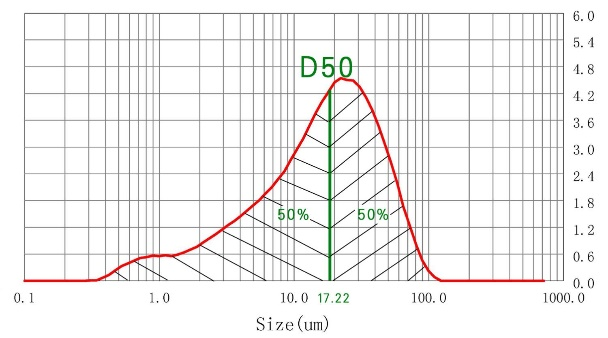
3. What is D50 (Median Particle Size)?
D50 refers to the particle diameter at which 50% of the cumulative particle size distribution is reached. It is also known as the median particle size.
For example, if a sample has D50 = 5 μm, it means:
- 50% of the particles are larger than 5 μm
- 50% of the particles are smaller than 5 μm
D50 is one of the most important and widely used indicators in diamond powder production and application, and it is often used to represent the average particle size of the material.
 |  |  |
4. What is D97 (Coarse Particle Indicator)?
D97 refers to the particle size at which 97% of the cumulative distribution is reached.
This means:
- 97% of the particles are smaller than D97
- 3% of the particles are larger than D97
D97 is commonly used to evaluate the coarse-end distribution of diamond powders. In industrial practice, some customers also require D95, D97, or D98 to strictly control the presence of oversized particles.
 |  |  |
5. Key Parameters in Particle Size Distribution Analysis
A complete particle size distribution curve typically includes the following parameters:
- Mean (Average particle size):The overall average size of the system
- Median (D50):The middle value of the particle distribution
- Mode (Peak size):The particle size with the highest frequency
- D10:Particle size at which 10% of the cumulative distribution is reached
- D50:Particle size at which 50% of the cumulative distribution is reached
- D90:Particle size at which 90% of the cumulative distribution is reached
These parameters together provide a full understanding of particle distribution width, uniformity, and consistency.
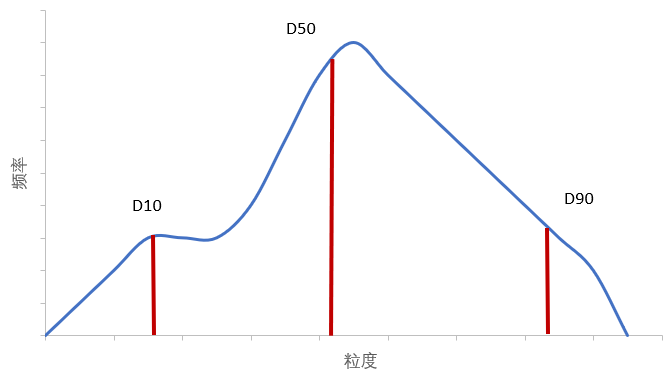
6. Schematic of Particle Size Distribution (D10 / D50 / D90)
In a typical particle size distribution curve:
- D10represents the fine end of the distribution
- D50represents the median point
- D90represents the coarse end of the distribution
The relationship between D10, D50, and D90 is widely used to evaluate the uniformity and grading quality of diamond powder.
Particle size analysis is a critical quality control parameter for diamond powder products. Accurate measurement and interpretation of indicators such as D10, D50, and D90 ensure consistent performance in polishing, grinding, and precision machining applications.